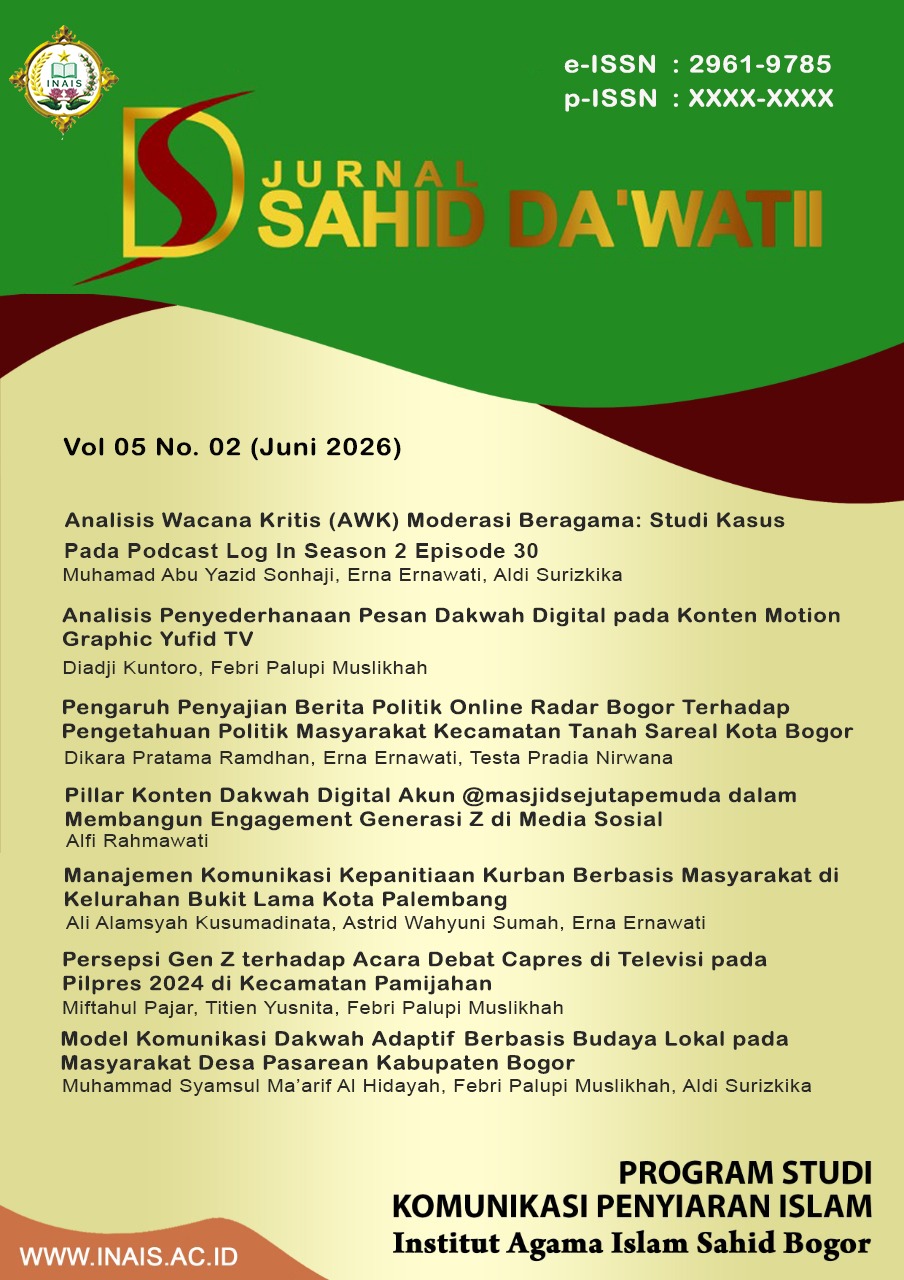





MANAJEMEN KOMUNIKASI KEPANITIAAN QURBAN BERBASIS MASYARAKAT DI KELURAHAN BUKIT LAMA KOTA PALEMBANG
Isi Artikel Utama
Ali Kusumadinata
Astrid Sri Wahyuni Sumah
Erna Ernawati
The implementation of community-based qurbani worship on a large scale has a high complexity of supply chains and field dynamics, so it requires structured communication governance. This study aims to descriptively analyze the communication management of the Qurbani Committee in Bukit Lama Village, Palembang City, using the analysis knife of George R. Terry's POAC Theory, Karl Weick's Organizational Information Theory, and W. Timothy Coombs' Situational Crisis Communication Theory (SCCT). The research method used was descriptive quantitative by distributing questionnaires to 100 respondents (Mudhohi and committee), complemented by in-depth interviews and field observations in May 2026. Data analysis was carried out using a descriptive statistical approach (mean score), cross-tabulation, and the Spearman Rank correlation test. The results of the study showed that the committee's communication management was very effective in the upstream phase (Pre-Event and D-Day). This is shown by the high average value of respondents' perception of the indicators of initial tariff clarity (4.44), ease of contract (4.54), and effectiveness of socialization (4.60). The highest success was achieved in the real-time slaughter documentation system (4.86), which successfully reduced information uncertainty (equivocality). Nevertheless, the mitigation of field crises (Crisis Center) is still considered sufficient (2.97) due to the immaturity of the one-stop public relations function. On the other hand, a drastic decrease (waterfall effect) occurred in the downstream phase (Post-Event), where the indicators of transparency of the publication of the Accountability Report (2.15) and the availability of feedback channels (2.04) were in the bad category due to the limited time and costs of the committee. This research implies the importance of the transformation of traditional committees towards modern organizations through the establishment of a special subdivision of Post-Event Public Relations to maintain accountability and sustainable public trust.