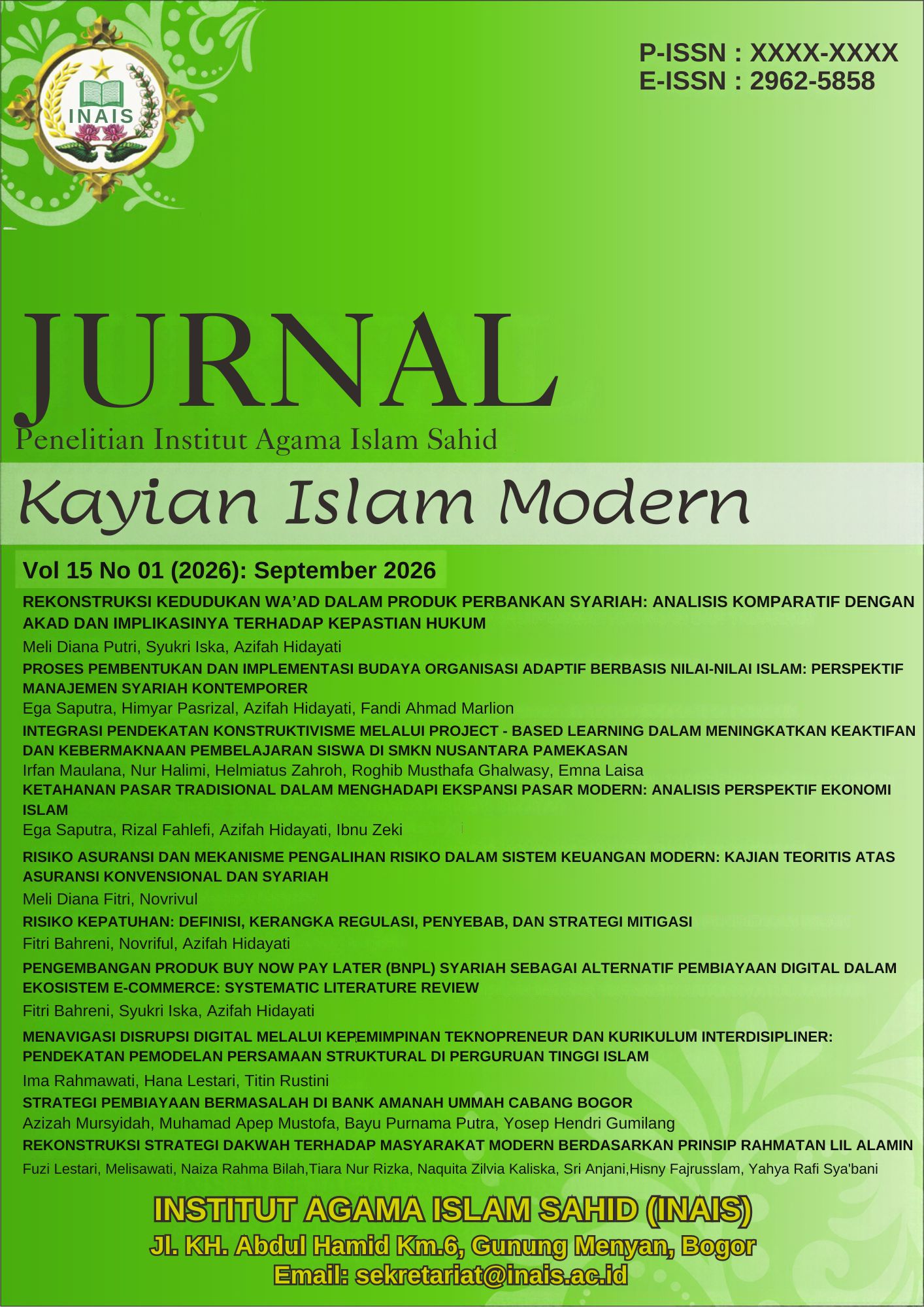













Rekonstruksi REKONSTRUKSI STRATEGI DAKWAH TERHADAP MASYARAKAT MODERN BERDASARKAN PRINSIP RAHMATAN LIL ALAMIN
Isi Artikel Utama
melisa Melisawati
Fuzi Lestari
Naiza Rahma Bilah
Tiara Nur Rizka
Naquita Zilvia Kaliska
Sri Anjani
Hisny Fajrusslam
Yahya Rafi Sya'bani
Da'wah in the era of modern society faces the challenge of social complexity that demands an inclusive approach as an antithesis to the phenomenon of exclusive and confrontational da'wah. The tendency of da'wah that is judgmental in nature triggers the urgency of reconstructing the da'wah strategy to restore the essence of Islamic teachings according to the prophetic treatise. This research aims to formulate a repositioning of da'wah strategies that are relevant to contemporary societal problems through the values of inclusivity, peace, and universal welfare, in line with the Islamic paradigm of Rahmatan lil Alamin. The research method used is library research with a descriptive-qualitative approach. The results of the study show that the reconstruction of modern da'wah must integrate the principles of peace and universality of compassion as an instrument for solutions to the problems of the people. Wasilah da'wah needs to be actualized through the use of polite and empathetic discourse (da'wah bil-lisan), as well as the manifestation of a real social role that is solutive (da'wah bil-hal). By internalizing the principle of rahmatan lil alamin, da'wah is no longer seen as a threat or judgment, but rather as a catharsis for spiritual crisis and social disorientation in modern society.
Al Turki, U., Kholish, M. A., Jamal, J., & Tohari, I. (2025). Rethinking Da'wah Strategy As A Basis For Mitigating Conflict Involving Muslim Minorities: Insights From Bali And Peniwen Malang, Indonesia. Teosofi: Jurnal Tasawuf Dan Pemikiran Islam, 15(1), 36-58.
Achmad, Z. A., Ida, R., Mustain, M., & Lukens-Bull, R. (2021). The Synergy Of Islamic Da'wah And Madura Culture Programmes On Nada FM Sumenep Radio, Indonesia. Jurnal Komunikasi: Malaysian Journal Of Communication, 37(2), 111-129.
Amin, S. M., Mahmudi Hanafiah, M. I. S., Zalikha, S., & Hadi, M. (2022). Strengthening Muslim Family Faith And The Importance Of Da'wah In The Digital Age. Indonesian Journal Of Islam And Muslim Societies, 10(1).
Eriyanto. (2022). Analisis Isi: Pengantar Metodologi untuk Penelitian Ilmu Komunikasi dan Ilmu-ilmu Sosial Lainnya. Kencana.
Farida, A., Saputri, Y., Faiziyyah, R., & Hanafiah, Y. (2021). Metode Dakwah Rasulullah Dan Relevansinya Dengan Tantangan Dakwah Di Era Revolusi Industri 4.0. Murabby: Jurnal Pendidikan Islam, 4(1), 12-22.
Hamid, A., Firdaus, M., Uyuni, B., & Farooq, H. S. (2025). Peace-Oriented Dakwah And Peacebuilding: A Critical Discourse Analysis In Conflict-Affected Middle East Societies. Jurnal Ilmiah Peuradeun, 13(3), 2043-2072. https://doi.org/10.26811/Peuradeun.V13i3.2057
Hibrizi, A. N. (2024). Unsur-Unsur Komunikasi dalam Dakwah Rasulullah SAW dan Implementasi Strategi Dakwah Rasulullah di Era Digital. Meyarsa: Jurnal Ilmu Komunikasi Dan Dakwah, 5(2), 116-126.
Hidayat, T., Perdana, J., Istianah, I., Saputra, A., Erlina, L., Saket, S. A. S., & Al-Gumaei, A. M. A. (2024). Social Media Da'wah Strategy In Implementing Islamic Da'wah. Asean Journal Of Religion, Education, And Society, 3(1), 51-58.
Hidayat, Y. F. (2022). The Construction Of Mohammad Da'wah To Umma Al-Da'wah In Hadiths Of Kutubus-Sittah. Ascarya: Journal Of Islamic Science, Culture, And Social Studies, 2(2), 169-180.
Husain, M. Z. (2025). Religious Moderation And The Development Of Multicultural Societies In Indonesia: A Normative-Islamic Legal Study. Asean Journal Of Islamic Studies And Civilization (AJISC), 2(1), 27-60.
Ishak, N., & Mikea Manitra, R. R. (2022). Constitutional Religious Tolerance In Realizing The Protection Of Human Rights In Indonesia. Journal Of Human Rights, Culture And Legal System, 2(1). https://doi.org/10.53955/Jhcls.V2i1.24
Maknun, L. (2024). Dakwah Era Digital: Studi Terhadap Permainan Mobile Legends Sebagai Media Dakwah (Tesis Magister). Universitas Islam Negeri Syarif Hidayatullah Jakarta.
Makhrian, A., Mat, N. H., & Noh, C. H. C. (2025). Instagram Based Da'wah And Worship Engagement Among Followers Of @Myquranbest. Multidisciplinary Science Journal, 8(6).
Mirzaqon, A., & Purwoko, B. (2022). Studi Kepustakaan Mengenai Landasan Teori dan Praktik Konseling Expressive Writing. Jurnal BK UNESA, 8(1), 1-8.
Mokhtar, A. B. bin, & Rahman, M. T. (2025). Between Love and Affection: Rahmatan Lil Alamin as a Transformative Axiological Framework in Global Education. FOCUS, 6(1), 37-54.
Moleong, L. J. (2021). Metodologi Penelitian Kualitatif (Edisi Revisi). Remaja Rosdakarya.
Munif, M., Idris, A. R., Yani, Z., Murtadlo, M., Munawiroh, M., Ta'rif, T., Saepudin, J., Junaedi, E., & Bahri, S. (2026). A thematic and bibliometric analysis of trends and future directions in da'wah research. Cogent Arts & Humanities, 13(1).
Najmuddin, M., Amri, M., & Aderus, A. (2022). Prophetic Communication: Islam As Knowledge Practice. Palakka: Media And Islamic Communication, 3(2), 98-111.
Ridwan, R., & Sari, H. (2021). Metode Komunikasi Dakwah Rasulullah (Kajian Tematik Dalam Kitab Shahih Muslim). Nukhbatul'ulum: Jurnal Bidang Kajian Islam, 7(2), 259-278.
Rijali, A. (2018). Analisis Data Kualitatif. Jurnal Alhadharah, 17(33), 81-95. https://doi.org/10.18592/alhadharah.v17i33.2374
Setiawan, R. A. (2025). Developing Rahmatan Lil'alamin-Based Islamic Religious Education In Indonesian Higher Education. Unisia: Universitas Islam Indonesia, 43(1).
Sugiyono. (2022). Metode Penelitian Kuantitatif, Kualitatif, dan R&D (Edisi ke-3). Alfabeta.